
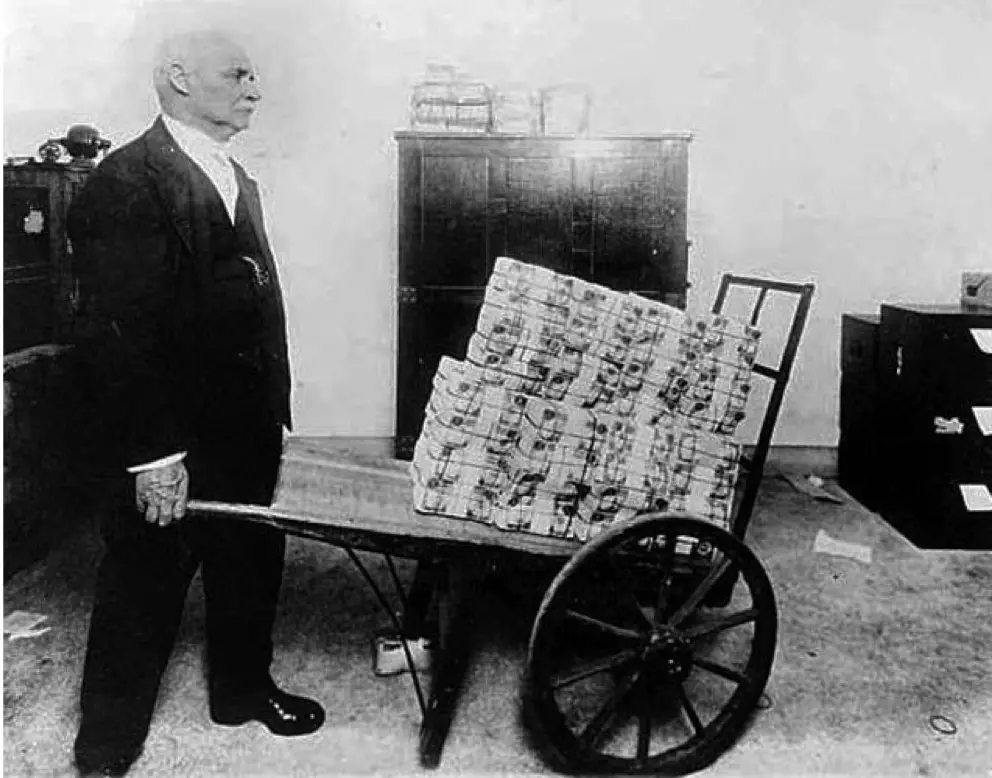
Fun hyperinflation fact: During the Weimar hyperinflation event of the early 1920s, wheelbarrows replaced wallets.
The US National Debt recently surpassed $35 trillion. Not surprisingly, the world is finally losing faith in our currency, as evidenced by the emergence of the BRICS trading bloc and its intention to introduce a new currency based on gold and, potentially, additional commodities. When that happens, the sell-off of “the almighty dollar” will begin in earnest. And as those dollars return to America, prices will increase at a rapid pace. That’s not a hyperinflation fact, per se. Nevertheless, it is a possibility.
For those who are looking for some fun hyperinflation facts, here’s a primer that explains this frightening event. It also highlights what we can expect if hyperinflation ever comes to America:
- Hyperinflation occurs when people lose confidence in their currency; it is cash in its death throes. As a result, they spend it as fast as they can – while it’s still worth something.
- As a currency enters its hyperinflationary death spiral, people naturally begin spending their increasingly-worthless cash on as many tangible goods as possible — whether they need them or not.
- Gold, silver, income-producing real estate, and fine art are the most effective ways of preserving wealth during hyperinflation. For those who are less well-off, consumer goods such as canned food, alcohol and cigarettes are effective hedges.
- Profiles in Cowardice: Hyperinflation takes time to manifest itself. It usually occurs only because affected leaders refuse to enact the painful policies typically required to solve the problem.
- Hyperinflation is probably more common than you think. Worldwide, there have been 56 hyperinflation events since 1900. Venezuela is the most recent example; other recent hyperinflation events include Argentina and Brazil in 1989, Russia in 1992, and Yugoslavia in 1994.
- Since 1913 the average rate of inflation in the United States has been slightly more than 3.5% per year. At that rate, prices double every 21 years. Unfortunately, since 2021, the average inflation rate has been much higher.
- Economists officially consider an economy to be hyperinflationary when prices increase 50% per month.
- Zimbabwe dealt with hyperinflation between 2006 and 2009. How bad was it? During the month of March 2007 the inflation rate there was 1730%. To put that in perspective, a $2 loaf of bread on March 1st would have cost $37 on the first day of April.
- By November 2008, the annual inflation rate in Zimbabwe was 89.7 sextillion percent. That’s 89.7 followed by 20 zeros. At that rate, prices were doubling every 24 hours.
- To keep up with inflation, the Zimbabwe Treasury printed bills with denominations as high as one hundred trillion dollars. (For a pictorial presentation of life in Zimbabwe with their astronomically-high currency denominations, check out this link.)
- The largest bank note denomination ever to be placed into circulation belongs to Hungary, which issued a 100 quintillion pengo note during its hyperinflation event in 1946. In case you’re wondering, “100 quintillion” looks like this: 100,000,000,000,000,000,000. How’s that for a hyperinflation fact?
- Perhaps the most famous example of hyperinflation is the one that struck Germany’s Weimar Republic shortly after World War I. The trouble started when Germany stopped backing its currency with gold and fired up their printing presses in order to finance the war. Then the presses continued printing after the war to help pay for reparations imposed upon Germany by the Allies. That was a bad idea.
- Immediately prior to World War I, the German mark was trading at a value of roughly five to the dollar. Less than a decade later, it took one trillion marks to buy a single dollar — which makes sense when you consider that in 1923 the Reichsbank was issuing 120,000 trillion marks per day.
- Before hyperinflation came to the Weimar Republic, the typical household spent 30% of their income on food and 30% on housing. By the time hyperinflation peaked in 1923, food expenses consumed 91% of German household income, while housing expenses fell to just 0.2%.
- With that in mind, it’s no wonder that, as Adam Fergusson notes in his book When Money Dies, by 1923 Weimar government officials were being paid in potatoes instead of cash.
- From Paper Money by Adam Smith: “Menus in cafes could not be revised quickly enough. A student at Freiburg University ordered a cup of coffee at a cafe. The price on the menu was 5000 marks. He had two cups. When the bill came, it was for 14,000 marks. ‘If you want to save money,’ he was told, ‘and you want two cups of coffee, you should order them both at the same time.'”
- No yolk: The hyperinflation in the Weimar Republic was so bad that in 1918 you could have bought 500 billion eggs for the same cash required five years later to buy just one egg.
- During the height of the Weimar Republic’s hyperinflation crisis, consumers found it cheaper to burn the currency than to use it to buy firewood. And as prices soared higher with each passing day, life became more surreal. And you can take that hyperinflation fact to the bank – in a wheelbarrow, of course.
Photo Credit: Public domain
I’m doing a story on the cause of the great depression and your website is proving to be alot of help, but I’m looking for even more detailed information. I found this article cause of the great depression but I’m not sure I believe the ‘official’ story… I’m looking for the ACTUAL cause of the great depression, if you have any sources of some other additional sources for info please hit me back.thank you
I’m glad you have found this website to be helpful. You might try this link if you are interested in the history of the Great Depression:
http://www.econlib.org/library/Enc/GreatDepression.html
I just passed this onto a colleague who was doing a little research on this. And he actually bought me lunch because I found it for him. So let me rephrase that: Thanks for lunch!
There were stories of workers in Germany demanding to be paid more than once per day so they could run to the store to make purchases before the money they earned for their day’s work deflated to the point where they couldn’t buy a meal. Wages were sometimes negotiated on a daily basis, or even more frequently.
Just remember, the most common “Good” are wages, the second is profits. If wages stay still, inflation does not have any chance of any large growing. You should never leave real estate out of the picture or changes in quality. It is also a quick means of paying off debt.
You’re right, paofpa — usually, wage increases are required to get price increases really rolling. However … the US is a little bit different in that the vast majority of US dollars (I believe it is close to 70%) are held off-shore in the form of both cash and treasury bonds. When the world has finally had enough of the currency debasement being perpetrated on our dollar by the Fed, they will return those dollars back to our shores, and I am certain that will be more than enough finish off the dollar.
Searching on the search engine DuckDuck Go (I use it because, unlike google, it doesn’t track you and sell the data to advertisers):
“attempts to replace dollar as reserve currency”
Turned up literally hundreds of discussions about ongoing movements of many governments and institutions to replace the U.S. dollar as the world’s reserve currency.
China and Russia have already established gold as the basis for their transactions buying and selling oil.
Yep. China opening the door to an oil-for-gold swap via the yuan is a mortal blow to the petrodollar regime that allowed the US to export its inflation to other nations. When that mechanism finally fails, it’s “game over” for the US dollar’s role as the world’s premier reserve currency — and Americans’ current standard of living.
I lived in Brazil during the hyperinflation in the 80’s. It was terrible. The prices went up so quickly that to “save” money we bought goods, as flour, vegetable oil, sugar (things that we would need in a short future) if we find those things in a reasonable price. In the grocery stores the prices changed from the morning to the evening. If you want to use your credit card the price of the good would be 100 percent more expensive. We changed our currency many times ( new names and new values) and just a very tight economic plan in 1994 put the things together again. I would hate see this happening here but I am afraid. I am just saying!
I can’t imagine the frustration of living in such a situation, Leasi.
Buying food is actually one of the best defenses for people who are unable to purchase gold or silver with their rapidly depreciating cash. Unfortunately, everybody quickly figures that out and the hoarding can lead to shortages.
Good article Len. Honest question: Wouldn’t you say that the US is like one of those “too big to fail” companies? I mean, there are LOTS of countries that completely depend in the almighty dollar. Doesn’t the US economy failing makes the world economy fail too?
And no, I’m not saying that everything will be all right, I’m curious about the ramifications of something like that(would love an article from you on that, or at least a good link too)
Yes, the US dollar is “too big to fail”, but it is a dying currency — and fail it will. The writing is on the wall for those who wish to see it: the world is rejecting our debased dollars with increasing frequency.
The only question is whether US leaders will try to keep the dollar’s hegemony as long as they can (which will result in hyperinflation and a lot of misery here in the States) — or do the right thing and agree to a new financial system that is representative of the United States’ real wealth, which will result in greatly reduced financial power (and a lower standard of living) for most Americans.
Man, I am actually scared now. Things like this make me rethink my bias against the permanent portfolio.
Great information though: makes you wonder what might happen after the US dollar isn’t the reserve currency.
Well, doesn’t a permanent portfolio call for 25% of your holdings to be in precious metals? (25% each in stocks, bonds, cash and precious metals.)
If so, then the 25% holding in PMs should be enough to at least maintain the value of your entire portfolio if the dollar collapsed — if not come out in a better position than you were before the crash.
Sorry Len, I DID know all 18 facts about hyperinflation. Just kidding, interesting how quickly things can change when the bill comes due. Sounds like a garden or a small farm would come in handy in such a situation. Interesting piece.
Maybe more than a small garden? Maybe a whole different way of life?
https://lenpenzo.com/blog/id22017-how-i-live-on-less-than-40000-annually-ralph-from-west-virginia.html
How do you recommend people acquire precious metals? Which metals do you prefer?
I prefer gold bullion coins, silver bullion and “junk” silver. You can buy precious metals at a local coin shop, or online.
For more info, send me an email at Len@LenPenzo.com and I will be happy to help you out.
Len- I would love to know how much PM you think an average middle class family should attempt to get. Please give a number of Ounces, not just a certain % of your wealth, or “as much as you can”.
I realize this is entirely opinion and speculation, but I owuld love your opinion.
You’re right, Tom — it’s all a matter of personal preference. And that depends on your convictions, your faith in the current monetary system, and your tolerance for volatility. It’s also important to fully understand WHY you are buying the PMs (i.e, I buy it as insurance, not as an investment — and I think everyone should look at it that way). Those who buy it as insurance care not about volatility or PM’s price from day to day — in fact, they prefer falling prices. Those who buy it to speculate are not only buying gold and silver for the wrong reasons, they also need a cast iron stomach because price is paramount to them and that can vary wildly.
I will send you a response by private email with some specific numbers.
If you want to understand the “death spiral” of hyperinflation in detail, check out this:
http://howfiatdies.blogspot.com/2013/09/hyperinflation-explained-in-many.html
Vincent: I’ve been to your site before. You did a great job.
Thanks Vincent.
What do you think about using the ETF’s GLD and PSLV for physical gold and silver in IRA accounts? Is there any alternative?
Hi, Mary. It is important to realize that gold and silver ETFs are not physical gold and silver. They are paper representations only! Yes, they say the shares are backed by physical gold and silver, but those shares are backed at a ratio of as high as 300 shares for every physical ounce — and the ratio is getting larger! In a market meltdown, everybody holding those paper shares will realize they have been had. The only gold and silver holders who will be protected in a currency crisis or other market meltdown will be those who buy physical gold and silver that they keep in their possession.
Let me be clear: IF YOU ALLOW OTHERS TO HOLD YOUR GOLD AND SILVER FOR YOU, THEN YOU ARE SUBJECT TO COUNTERPARTY RISK!