
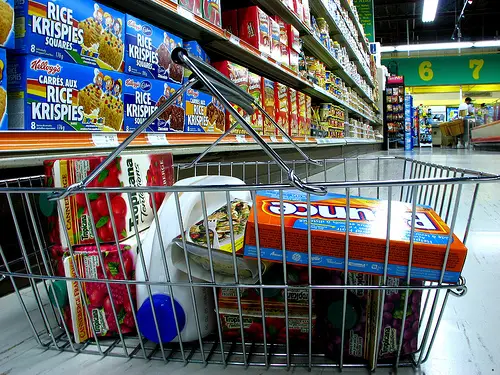
 Food isn’t cheap.
Want proof? Then chew on this: I spent almost $12,000 in groceries last year for my four-person family, including two teenagers.
And what’s really scary is that I work very hard to keep my food bill as low as possible every year. I shudder to think how much more I’d expend on groceries every year if I didn’t try to control costs.
There are many methods for cutting your grocery bill that go way beyond shopping at discount grocery stores, taking advantage of in-store specials, and using coupons. I maximize the savings on my household food bill by focusing on three key areas:
1. Dinner Menus
2. Grocery Shopping Strategies
3. Pantry Management
In Part 1 of this series I focused on the key tips that I use to keep the family grocery bill under control with respect to planning and development of the family dinner menu. Today in Part 2, I’ll focus on 10 key shopping strategies I use to keep my family grocery bill under control. Here they are:
- Make a shopping list and stick to it. Every two to three weeks the Honeybee sits down and carefully makes her shopping list based upon our multi-week dinner menu. In fact, the list she makes is so well-organized that it’s written in aisle-by-aisle order. In other words, the top of the list corresponds to one end of the store and the last item on the list is at the other end of the store. Sure, there’s a little more time involved, but the extra effort pays off at the checkout counter by reducing impulsive purchases. It’s also more efficient.
- When practical, shop by per unit costs. You can’t always assume that products in larger-sized packing is always a better value. Luckily, the per-unit cost of a grocery item can usually be found on the store shelf, marked in smaller print below the main price.
- Watch expiration dates when buying in bulk. Before buying perishable groceries in bulk, make sure you can consume it all before the date your food becomes inedible, otherwise that extra savings you thought you were getting by buying in bulk will have been wasted.
- Shop on a full stomach. The evidence may be anecdotal, but in the rare cases I end up doing my grocery shopping on an empty stomach, my grocery bill ends up being five to ten percent larger.
- Beware of featured items on the “end caps.” As many of my readers know, I used to work in a grocery store, so I am speaking from experience here. The items you see at the end of each grocery aisle, known as the “end caps,” are not typically the areas where you’ll get great deals — they’re a sneaky grocers’ trick often used to push high-profit items. Oh, sure, grocers like to make the end caps look festive and boldly advertise the price as if it were a good deal, but they’re usually not. In fact, those end caps are where many grocery stores make much of their profit.
- Beware of items at the checkout line. Just like the items on the end caps, you need to avoid the candy, gum and magazines you’ll find at the checkout line. These items are high-profit-margin products that can really run up your bill.
- Buy store brands. Did you know that, sometimes, store brands are the national brands with a different label on them? It’s true. Even when they’re not, the store brands will be virtually identical to their name-brand counterparts. Well, except for the higher price tag.
- Sign up for customer loyalty programs. Most large grocery chains have a customer loyalty program. Many advertised sale prices only to apply to your grocery bill if you use your customer loyalty card.
- Buy meat closer to its “sell-by” date. Whenever possible, take advantage of butcher’s specials on meat that is approaching the sell-by date. The US Department of Agriculture suggests cooking or freezing ground beef within two days after purchase for maximum quality.
- Be wise when using coupons. Of course, coupons are a great way to save money. I don’t usually advocate timing your coupon use to coincide with corresponding sales on a particular product, as the extra savings are too erratic. In addition, depending on how far your grocery store is from your house, your potential extra savings for a particular product could be eaten up by the cost of gasoline driving to the store. And if you’re one of the five people left in America that still reads a newspaper, keep in mind that many Sunday coupons happen to coincide with the front end of product promotions, when prices tend to be higher.
The more of these tips you can utilize, the bigger the savings you will realize on your grocery bill. As you can see, most are very easy to implement. All it takes is a little commitment from you to turn these tips into real savings!
Next, I’ll focus on pantry management techniques in Part 3 of this series that will help you save even more on your grocery bills.
Photo Credit: Matt MacGillivray
(This is an updated version of an article that was originally posted on March 26, 2009.)
I use a lot of these tips and find they really help. You can save a lot of money by reducing the number of trips you make to the store too. The chances of picking up something extra each time you walk into the store are high – go in as infrequently as possible 🙂
I agree, Nicki — especially if you shop in one of those stores that has a Starbucks in it. For many folks, that’s four or five bucks down the drain right there before they even get what they’re looking for.
Thanks for the great tip! 🙂
Len
My favorite tips are the list and buying store brands. Those two alone can save you a fortune.
My first reaction to your grocery bill was, “Wow, I’m glad we don’t live in California!!!”
Some additional universals that may help others. Use cash. That makes a huge difference, when it’s gone you stop. Any extra is set aside for a “really good stock up sale”. We have a small raised bed for tomatoes and basil. From it I can sauce for the year. Shop at a bump and dent grocer. (They buy at auction and resell). That usually saves us about 20% off regular prices. Use less meat. Shop seasonal vegetables and cheap standards like cabbage and carrots. Find alternative sources. We get our eggs from a farm lady near a route my husband takes every other week, so we stock up. Hope these ideas help others.
Are you kidding me. You speent $12,000 on groceries and are just coming up with these ideas. I have a family of four that includes a teenager, an infant and a dog. I spend less than $3,000 a year on groceries. The key is to stop buying processed food and make it from scratch. A box of rice-a-roni costs over $1 but if you make rice with chicken broth and a little seasoning it will cost less than $0.20. The other key is to make the right amount of food. leftovers are not an opportunity for a chip meal later on, they are an invitation to eat more than you need to satisfy and a way to spend more money on food. Buy and cook what you need, not what you think you want and you will save a fortune.
A for effort, F for reading comprehension. The end of the article clearly says “This is an updated version of an article that was originally posted on March 26, 2009.” So no, he’s not just coming up with these ideas.
Out of curiosity, does your total of 4 actually include the dog? If so, that’s a huge discount on your grocery bill, as pet food tends much cheaper than human food, barring special diets.
Yes, Kelsey … the total grocery bill includes the dog food, biscuits and other treats too. We spend about $400 annually on that stuff. 🙂
$12,000 is a huge amount to spend on groceries! We keep ours to between $6,000 and $7,000 every year and that includes all meals 7 days a week.
Granted I don’t have 2 teenagers, so perhaps it will increase with time along with my family.