
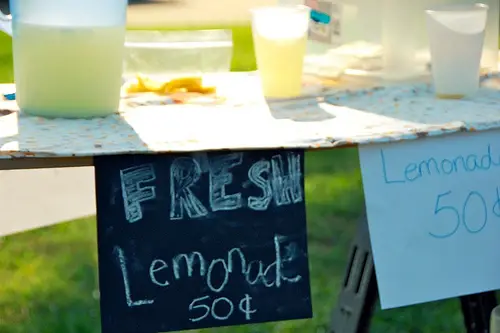
 Each Father’s Day, I love to reminisce about the joys of fatherhood and the days when my teenage kids were younger. This year, I caught myself looking back upon the time several summers ago when my business-savvy daughter, Nina, set up a wildly successful corner lemonade stand. Well, that is, as successful as you might expect a 10-year-old girl’s lemonade stand to be.
In the first hour after she opened for business, she had earned a little over ten dollars selling lemonade — for the bargain price of fifty cents a glass — to neighbors walking and driving by her stand.
By the time the second hour rolled around, business was booming. In fact, it was going so well that Nina suddenly found herself competing with a second lemonade stand another kid had set up on the opposite corner, much to her chagrin.
Kids and the Fundamentals of Capitalism
I can still remember the amusing sight of the competing stands like it was yesterday. Not only did Nina have to work harder when the second lemonade stand opened up across the street, but she was also forced to lower her price too. And although she continued making money, the new competition kept her earnings much lower than what she had experienced in that first glorious hour of business.
Later that evening during dinner, Nina complained to us about how the competition had kept her from earning more money — proving that even younger children are wise enough to understand the market power of a monopoly.
Of course, every grown-up businessman dreams of having a virtual monopoly in the marketplace too, but there are only a very few companies that actually have the good fortune to be in such a position.
Lemonade Stands Aren’t the Only Monopolies Out There
Awhile back, I read an article that discussed three companies with virtual monopolies. That is, although they don’t control 100% of the market, they dominate their market niche to such a degree that they actually have little or no competition. The highlighted companies were: ESPN, Google, and Monsanto.
While I disagree with the article’s first example — most folks can watch various sports on plenty of other television channels without having ESPN — I thought the other two were spot-on.
Still I can think of a few other virtual monopolies out there that really frustrate me because of the lack of competition.
1. Satellite radio. In the United States, it used to be that if you wanted to subscribe to satellite radio you had two companies to choose from: Sirius and XM. In 2008, those companies merged. Now, if you want satellite radio you’re going to subscribe to Sirius XM, dammit, or you aren’t going to subscribe at all. Siriusly.
2. Ticketmaster. I hate Ticketmaster. After all, these guys are typically the only game in town, handling upwards of 80% of all ticketing for live events in the United States. After its merger with Live Nation, the new Ticketmaster became even more powerful, with managing interests in approximately 350 artists, and exclusive booking deals with more than 125 venues around the country.
3. My local cable company. Between 1995 and 2013, cable television prices increased at a compounded growth rate of 6.1% annually — that’s more than double the official rate of inflation over the same period. I think a lot of that has to do with cities like mine that award exclusive cable franchises within their boundaries. Don’t like your cable company or their customer service? Boo hoo — and no soup for you!
It’s late so I’m going to stop here; but I’m sure you can think of a few others that I probably missed.
While us consumers rightfully tend to hate monopolies, most business owners wish they could be so lucky. I know Nina still laments the demise of hers.
Photo Credit: eren (sea+prairie)
While I don’t like it, I do understand why cities provide one cable company operating rights within their boundaries. There is a HUGE capital investment in running cable lines to every house within an area. If there were 4 cable companies each having to run lines and not being guaranteed a certain amount of business, then it wouldn’t be financially feasible for them to run the lines.
That’s just the cable companies’ argument. Why can Verizon and AT&T install new fiber throughout various neighborhoods without having a city-sanctioned monopoly? They are willing to spend the money (investment) in the expectation that they have a better product (fiber optic internet/television/phone service) and that people will be willing to pay for said product.
@Chris: The cable companies like to argue that cable television is a natural monopoly – that is, operating and infrastructure costs make it such that there is no way for more than one company to be profitable, much like the electric company. But that is simply not true, as there are many cities out there with multiple cable companies successfully operating within their city limits. The cost of stringing an extra cable on existing utility poles is not onerous for the cable companies.
Let me point out that the concept of cable as a “natural monopoly” dates to the era when cable TV was just that, and considered a luxury. With cable one of the best ways to deliver broadband internet access which is rapidly moving into the realm of being a necessity (for homes, that is. For businesses it has been for years, and the smaller the business the more crucial the access becomes), it’s time for a rethink.
Time to branch out and get some pink lemonade or Kool Aid or even Crystal Light (no calories!).
That’s similar to what I was thinking. Or adding homemade baked goods like brownies and cookies. This make you thirsty so you have to buy the drinks.
I love kid’s lemonade stands. Living in a large city, you don’t see them much. Perhaps fear of strangers or theft?
Don’t forget the electric company too!
Start selling cookies and flowers along with the lemonade, and then move into cheap furniture 😛
Poor Nina! Had those other kids been smart, they would have set up around the block or something, as they hurt their own profit too.
I hate monopolies myself, but sure wouldn’t mind owning one. Next year, Nina needs to take it to the next level and find a competitive advantage!
I definitely don’t get why the cable companies are allowed to have monopolies! Competition is usually a good thing in our society, and we would definitely see a benefit in both prices and products!
Lemonade stands on Len’s street are like Starbuck coffee stands at my work.
Your daughter is smart! It’s good that she learned early; we didn’t learn about what monopolies really were until senior year in AP Econ
I’m glad you liked the post. It’s true. Monopolies are a bad deal for consumers but they are great for businesses. That sucks…only two hours and competition popped up.
On another note, my son just sold his lollipop to someone in school who offered him $5. “Done” he says!. Goes to show some folks will “pay up”! After he sold it, he got a $6 bid!
Wait till the other son’s mom find out!
Learning about capitalism the hard way!
@Ron: Branch out at WHOSE expense? LOL What’s really great when you have a kid business like a lemonade stand is there are ZERO start-up costs because Mom and Dad subsidize operating expenses!
@Kendra: As I mentioned to Chris, I subscribe to the opinion that the electric company is a natural monopoly that makes it too difficult for more than one company to operate profitably.
@FB: Yes! They’ve actually done that in past years.
@Everyday: Oh she’ll live. But you’re right, she probably needs to go back to the cookies.
@Khaleef: There really is no good reason for cable companies to have monopolies. People need to complain to their city councils.
@Jenna: I know, they’re everywhere aren’t they? It’s a wonder how they all stay in business.
@Briana: Nina definitely has a pretty good business sense for her age.
@Mark: That’s okay. The free market works at all levels – even kids’ lemonade stands! Besides, it was a great teaching moment for Nina that showed her that capitalism is all about competition.
@Mr. CC: Uh-oh… Good luck with that! LOL
My kids are more entrepreneurial than most adults I know. They’re trying to sell veggies out of our garden, sell pictures, sell anything. They love the idea of making money. And I barely talk about money with them – they’re too young to turn them into little Trumps. I guess as people age, apathy sets in and they lose that fire.
This is why businessmen who become politicians are to be no more trusted than any other politicians; in fact, they are even less to be trusted because they KNOW how their position of advantage can help their friends make more money. If your daughter had the power to, she could have legislated that only one lemonade stand per block be allowed, for traffic safety reasons or something like that. 😛 Nice post! I enjoyed it.
@Darwin: A lot of kids really have a nose for business. Nina is one of them. My son, not so much. He is just happy to be a mass consumer.
@BIFS: Yep. I know exactly what you mean. It is a rip off.
@InvestIt: LOL Ah yes, more intervention from our wise government! Glad you enjoyed the post. 🙂
Oh, I hate TicketMaster! Our Transiberian Orchestra tickets are $80-90 but with all the extra fees, it more than $120! Grrrr…
I know somebody that knows somebody that knows somebody that for a small fee, he would destroy that other lemonade stand. haha
I think cable companies are the worst. I don’t have TV but I do have to get internet from them and I only have two options because… I really don’t know why. If all cable companies really competed with each other, then their prices wouldn’t be so abusive.
Maybe you should have educated your daughter in about another great capitalist tradition: collusion! Why compete on price when we can secretly agree to the same, higher price and both make more money! 🙂